
Virtual Incision Receives FDA 510(k) Clearance for the MIRA™ Surgical System in Benign Hysterectomy Procedures
Expanded indication extends the first miniaturized robotic-assisted surgery platform into one of the highest-volume soft tissue specialties
LINCOLN, Neb. — August 25, 2026 - Virtual Incision Corporation, developer of the MIRA™ Surgical System (MIRA), today announced that the U.S. Food and Drug Administration has granted 510(k) clearance for the use of MIRA in benign hysterectomy procedures. MIRA received De Novo authorization for use in adults undergoing colectomy procedures in February 2024 as the world's first miniaturized robotic-assisted surgery (miniRAS) device.
More than one million women in the U.S. undergo surgery for benign gynecologic conditions each year.¹ A minimally invasive approach can shorten hospital stay, reduce blood loss, and decrease complication rates compared with open surgery.
The clearance was supported by outcomes from the MIRA Surgical System Hysterectomy IDE Study, a prospective clinical study conducted by five surgeons across three U.S. hospitals that confirmed the system’s safety and performance in benign hysterectomy procedures. “Receiving an indication within benign gynecologic surgery represents a tremendous step forward for our technology,” said Piet Hinoul, M.D., Chief Medical Officer at Virtual Incision. “We are deeply grateful to the patients who participated in the study and to the surgeons who placed their trust in our team and technology. Their commitment and collaboration were instrumental in achieving these strong clinical results.”
Professor Ricardo Estape of the HCA Institute for Gynecology and Gynecologic Oncology, and principal investigator of the study, stated: “This system is uniquely differentiated among soft-tissue surgical robots. Its unique design makes the procedure simple and repeatable, while its compact form factor requires virtually zero operating-room footprint. These features make it ideally suited for routine elective procedures that can be safely and efficiently performed in all sites of care even in ambulatory surgery centers, community and rural hospitals.”
“Women’s health has historically been underserved, and this disparity is particularly apparent in robotic assisted minimally invasive surgery. The MIRA surgical system is aimed at closing the gap and providing all patients access to cutting edge robotic technology in all sites of care.” said Jim Alecxih, Chief Executive Officer of Virtual Incision.
Today, MIRA is commercially available in the United States for colectomy procedures. Virtual Incision is following a staged approach for indication expansion, and the broad use will be introduced commercially in a subsequent phase of the company's platform roadmap. The company will announce timing for commercial availability in gynecology in the near future.
About the MIRA Surgical System
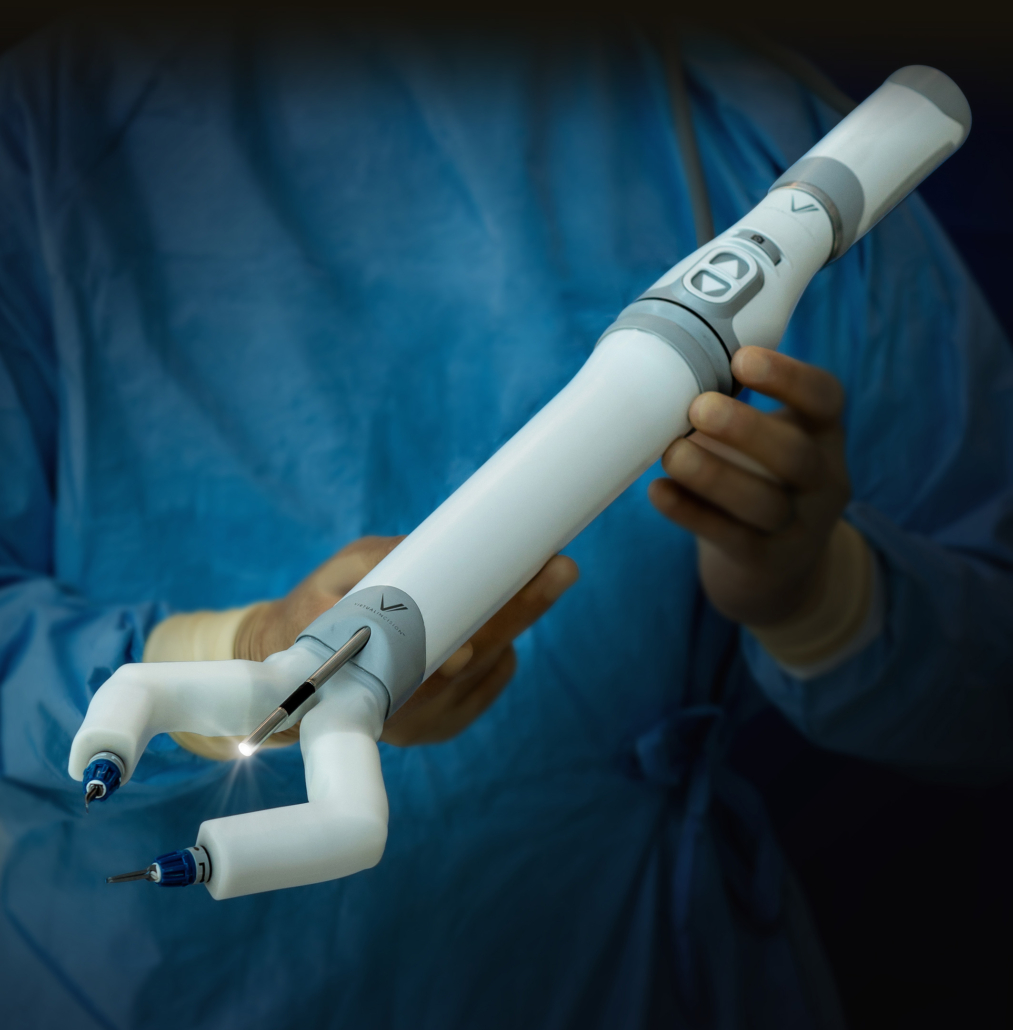
MIRA is the world’s first miniaturized robotic-assisted surgery (RAS) system. Its small, sleek form factor is designed to offer the benefits of RAS during colectomy and benign hysterectomy procedures without the logistical inefficiencies of traditional mainframe robotics. The easily accessible device weighs approximately two pounds (less than one kg) and offers internal triangulation with shoulders, arms, and infinite wrist roll inside of the body. It can be used in any operating room – a dedicated mainframe room is unnecessary. With its drape- and dock-free design and portability, MIRA is quick to set up, clean up, and move between cases. Its conveniently accessible design positions it to be used as a standalone system or a complementary tool for facilities that already own a mainframe. With MIRA, every operating room is RAS-ready.
About Virtual Incision
Virtual Incision is on a mission to simplify robotic-assisted surgery (RAS), so more patients and their surgeons can access its benefits every day. Headquartered in Lincoln, Nebraska, and holding over two hundred patents and patent applications, the company developed MIRA, the first-of-its-kind miniature RAS system. Virtual Incision’s goal is to make every operating room RAS-ready. For more information, visit our website or follow us on LinkedIn and X.
Forward-Looking Statements
This communication contains statements that constitute “forward-looking statements” within the meaning of the Private Securities Litigation Reform Act of 1995. Forward-looking statements include but are not limited to, statements regarding our plans, beliefs, expectations, assumptions, and other statements that are not necessarily historical facts. You are cautioned that these forward-looking statements are only predictions and involve risks and uncertainties. Further, any forward-looking statement speaks only as of the date on which it is made, and we do not intend to update or revise any forward-looking statements. This communication also contains market data related to our business and industry which includes projections that are based on several assumptions we believe are reasonable and most significant to the projections as of the date of this communication. If any of our assumptions prove to be incorrect, our actual results may significantly differ from our projections based on these assumptions.
¹ Source: Life Science Intelligence 2021 Report on Obstetrics and Gynecology.